
2026-09-04
Ecommerce data MCP — query 1.37M Shopify stores from chat
1.37M
Shopify stores in the catalog
368.9M
SKUs tracked
60
MCP tools (playbooks + catalog)
Source: EcomScout catalog, pulled 2026-09-04. Coverage from get_analytics_overview / GET /v1/analytics/overview.
The 40-second demo
We recorded the Product Hunt cut: mint a 14-day trial, hit Gymshark on the catalog, show the JSON the API actually returned. No voiceover essay. Watch it, then the screens below are the same frames with the numbers written out.
What people type vs what exists
Ahrefs US, 2026-09-04. “ecommerce mcp” is 10 searches a month. “shopify mcp” is 700 — and that SERP is Shopify Inc’s own store-side MCP (connect your shop to an agent), not a 1.37M-store catalog. We do not pretend we outrank that. The jobs people actually have are “ecommerce intelligence” (200/mo, KD 1), “shopify product research” (60), “shopify store database” (100), and “shopify competitors” (1,300, KD 7). Those are the pages this post is for.
| Query | Vol / mo | KD | CPC |
|---|---|---|---|
| shopify mcp | 700 | 26 | $3.00 |
| ecommerce intelligence | 200 | 1 | $5.00 |
| ai ecommerce tools | 200 | 16 | $6.00 |
| shopify product research | 60 | 7 | $2.50 |
| ecommerce data api | 50 | 3 | — |
| ecommerce mcp | 10 | 0 | — |
Source: Ahrefs Keywords Explorer. Country=us, 12-month average monthly volume. CPC is USD (API cents ÷ 100). KD 0–100. Pulled 2026-09-04.
| Query | Vol / mo | KD | CPC |
|---|---|---|---|
| mcp server | 41,000 | 31 | $3.00 |
| model context protocol | 15,000 | 85 | $2.50 |
| shopify competitors | 1,300 | 7 | $3.00 |
| shopify store database | 100 | 23 | $2.50 |
| shopify store list | 60 | 5 | $0.90 |
Source: Ahrefs Keywords Explorer. “mcp server” (41k) and “model context protocol” (15k) are the protocol, not a product. We do not chase those SERPs.
Example numbers from the catalog
Same snapshot as the US market page. The US is 605,829 stores (5.9% dropship). India is sixth and almost clean of dropship flags (56,821, 0.9%). Apparel is the crowded room. Footwear has fewer shops and more visits per shop.
Source: EcomScout catalog, pulled 2026-09-04. GET /v1/analytics/countries. Dropship % = round(1000 × dropshippers / stores) / 10.
Source: EcomScout catalog, pulled 2026-09-04. GET /v1/stores?groupBy=vertical&minVisits=1000. Floor drops parked shops.
How to use it
- Open /start. One click mints a 14-day trial (100 lookups/day, 20/min, no account) and looks up Gymshark so you see a real card before you install anything.
- Hit Connect Cursor (or Claude). The connect URL already has the key in the path. Accept the MCP prompt. You do not paste
nj_. - In chat, ask a job — not “what can you do.” Start with
whoamiif you want quota, thenlist_playbooks, then one composed tool. Do not invent catalog numbers. If the store is missing, the tool returnsnot_found. That is final.
REST is the same catalog: GET https://mcp.neonjelly.io/v1/… with the bearer token. The playground runs cached examples so you can read JSON without burning trial quota.
Asks that hit a tool
“Look up gymshark.com — visits, modeled revenue, SKU count.”
resolve_store / get_store
“20 United States skincare stores, >10k visits, email on file.”
find_outreach
“Is a neck fan saturated? Seller count and who sells it.”
niche_research
“Vendors supplying hoodies under $25, and which stores use them.”
source_map
Demo screens, one by one
Same sequence as the Arcade / Product Hunt walkthrough. Each frame is a step you can still do on the live site.
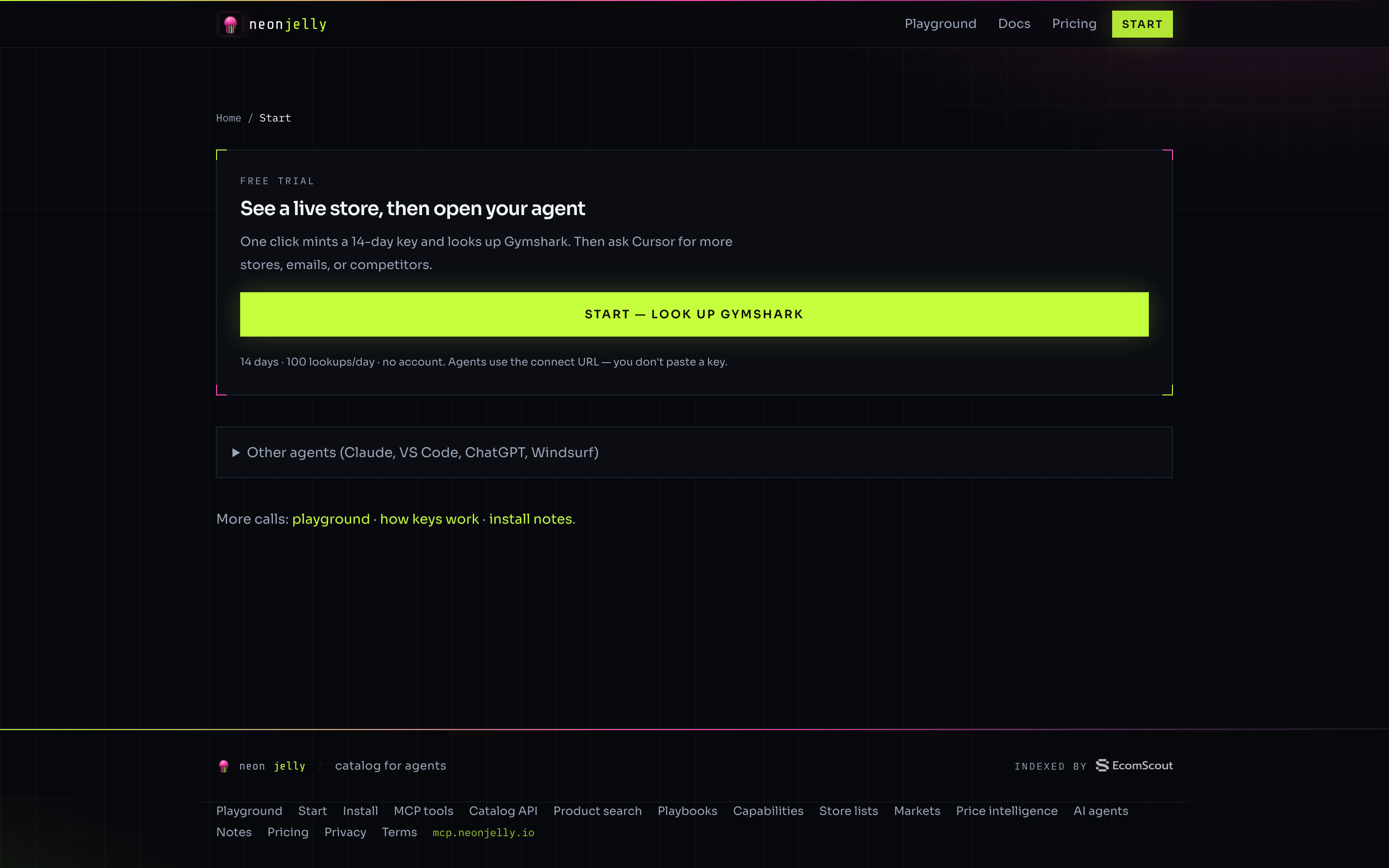
This is the whole onboarding. No signup form. The lime button mints a 14-day key and immediately runs GET /v1/stores?q=gymshark. Claude, VS Code, ChatGPT, and Windsurf sit under the fold — Cursor is the default because that is the client most people have open already. Trial terms on the card: 100 lookups/day, agents use the connect URL, you do not paste a secret.
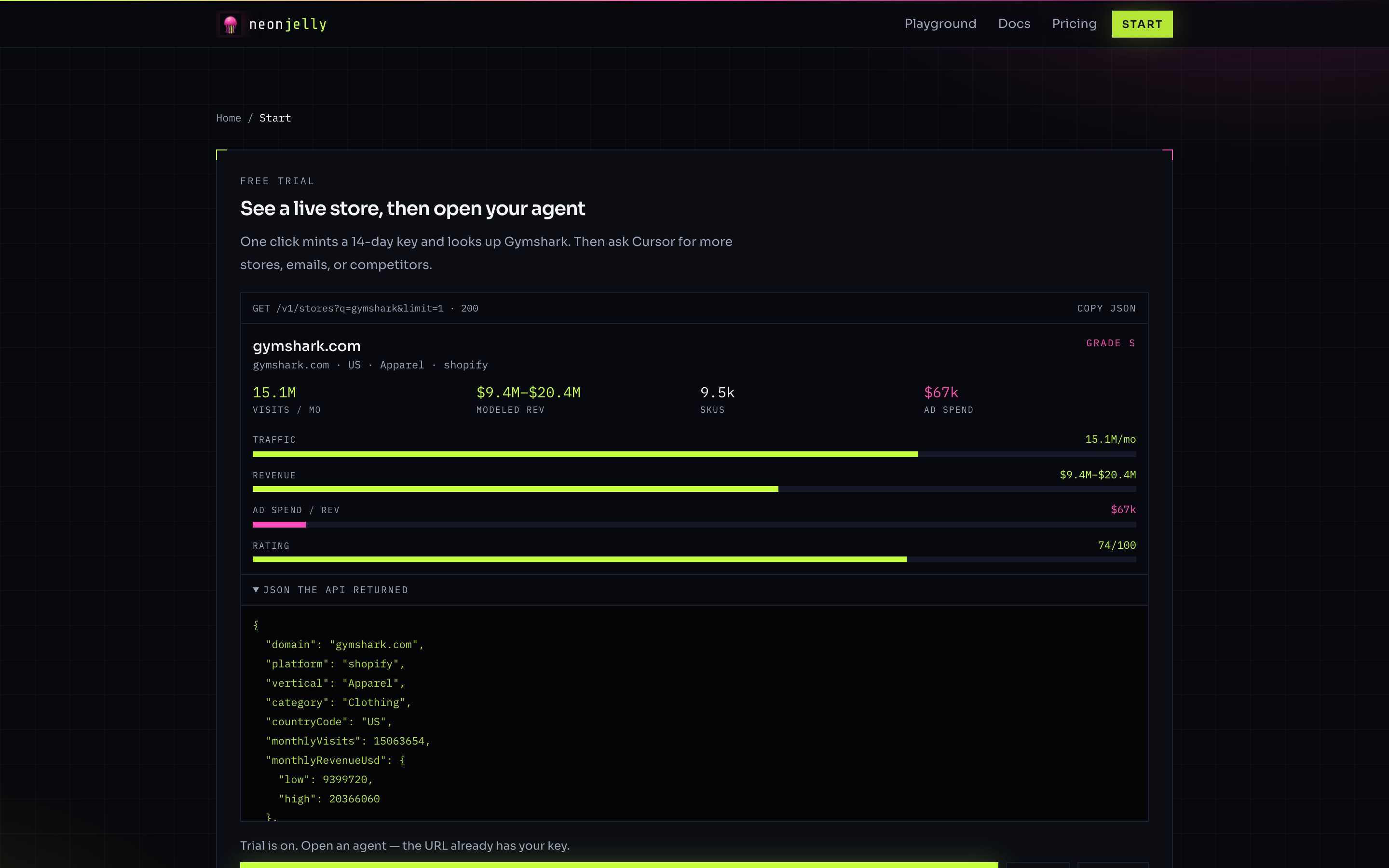
After the click you get a merchant card, not a spinner essay. This snapshot: gymshark.com, US, Apparel, Shopify, grade S. 15.1M modeled monthly visits, revenue band $9.4M–$20.4M, 9.5k SKUs, about $67k ad spend, rating 74. The JSON block under the bars is the same payload an agent sees. If those numbers ever disagree with chat, trust the tool — the model did not invent a second Gymshark.
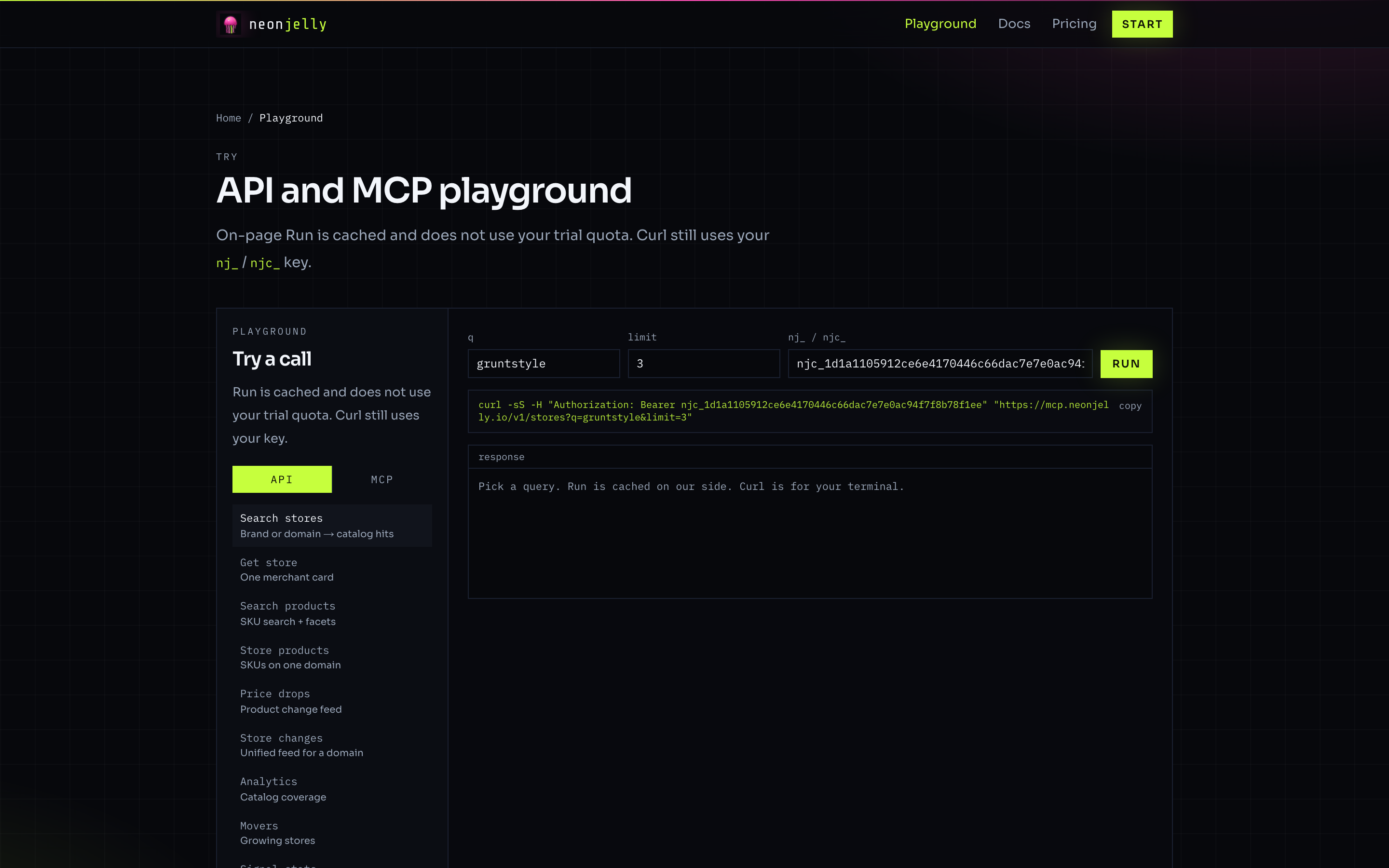
Playground is for humans who want the curl. Toggle API vs MCP. “Search stores” with q=gruntstyle and limit=3 is the default because brand → domain is the first resolve most people need. The box writes the exact Authorization: Bearer request to https://mcp.neonjelly.io/v1/stores. On-page Run is cached on our side. Use that when you are learning the shape. Use your own token in a terminal when you want a fresh row.
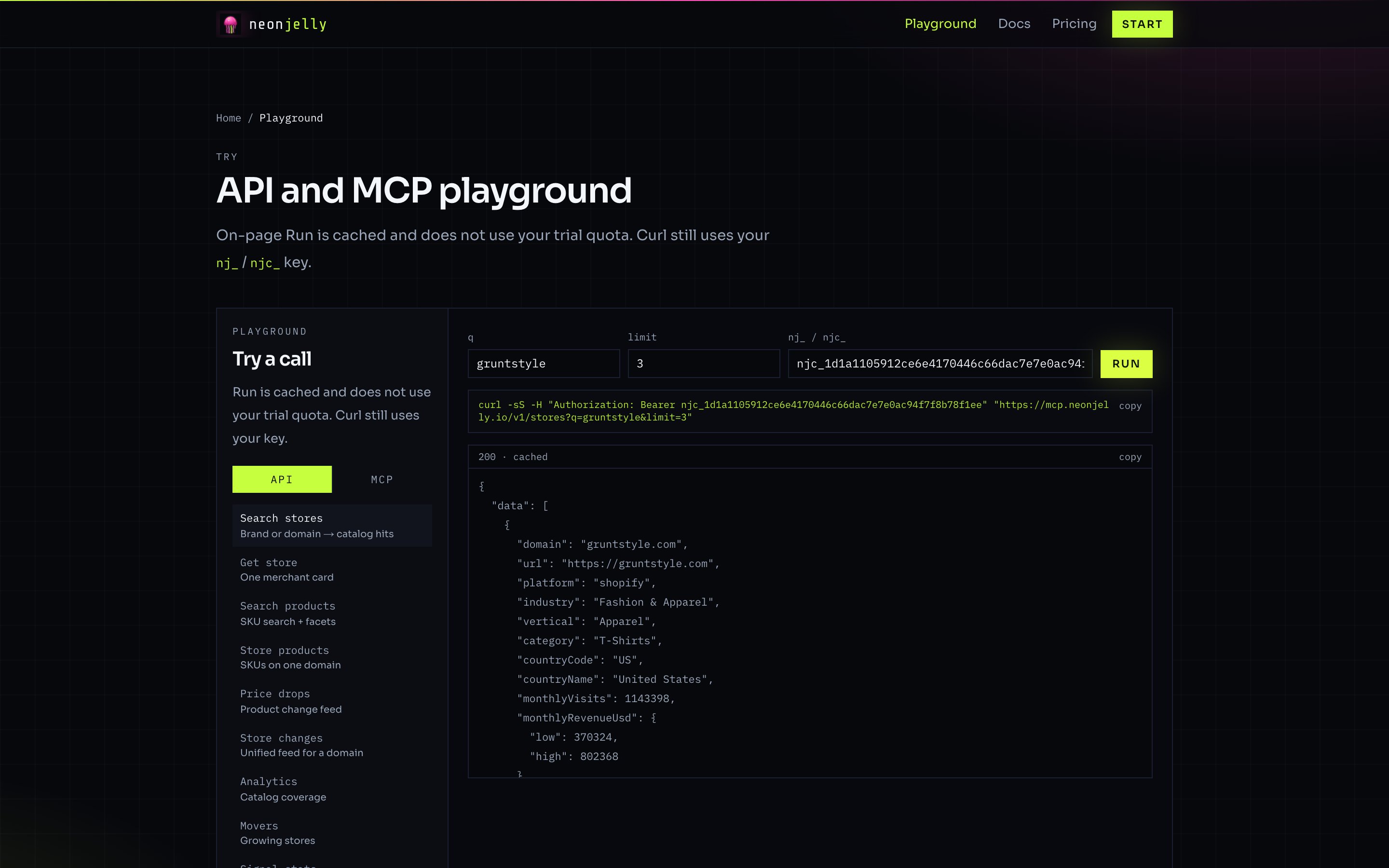
Cached 200 for Grunt Style: Shopify, fashion / T-shirts, US, about 1.14M monthly visits, modeled monthly revenue $370k–$802k. That is a different planet from Gymshark’s 15M — same tool, same schema, different store. Once you see two cards side by side you stop asking the model to “estimate traffic.” You ask it to call compare_stores.
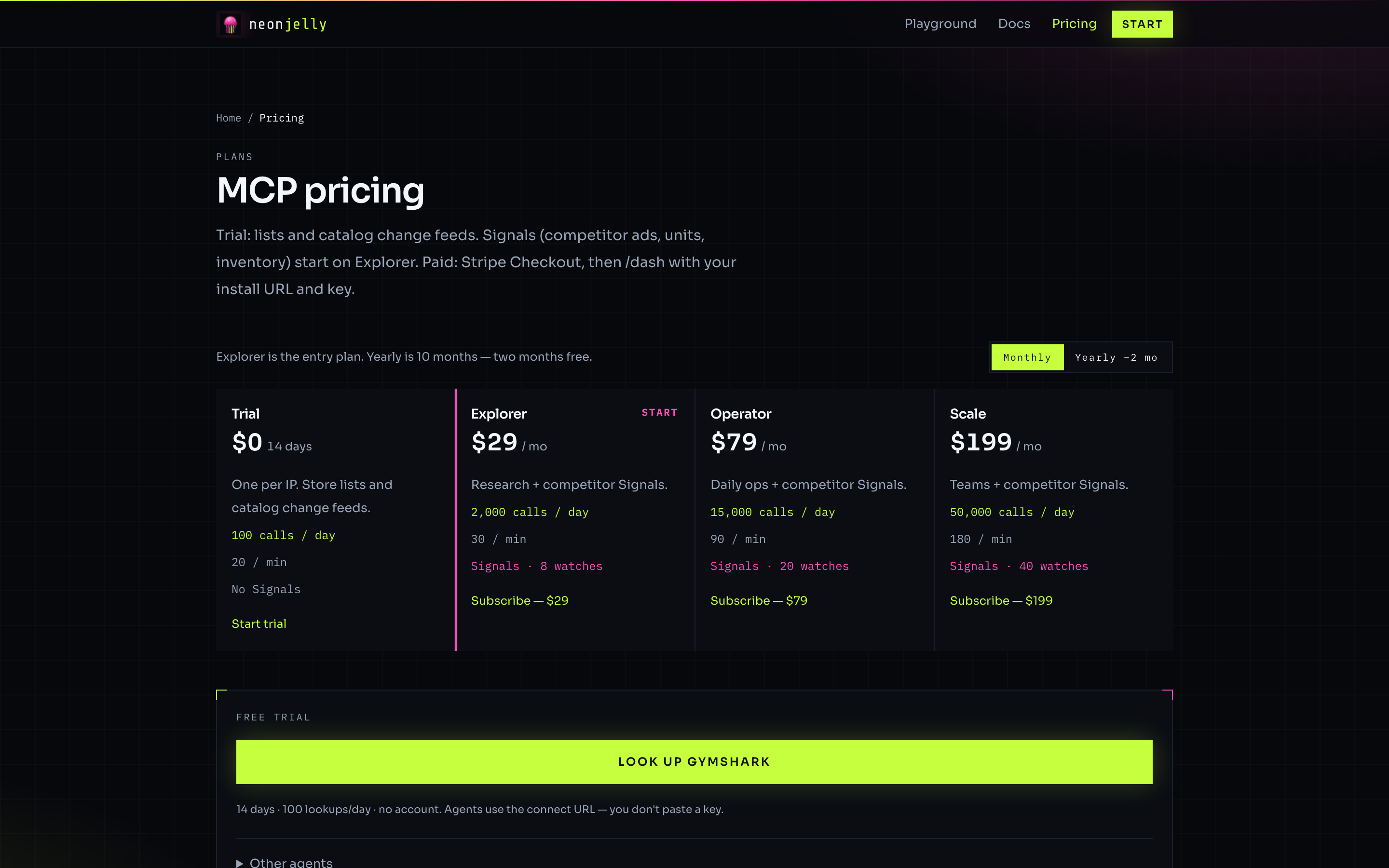
Trial is lists and catalog change feeds. Signals (ads, daily units, inventory on a watched competitor) start at Explorer. Caps on this shot: Trial 100/day; Explorer $29 · 2,000/day · 8 watches; Operator $79 · 15,000/day · 20 watches; Scale $199 · 50,000/day · 40 watches. Yearly is two months free. Promo LAUNCH is 50% off the first three months, expires 31 Oct 2026. A trial create_signal returns 403. That is intentional, not a bug.
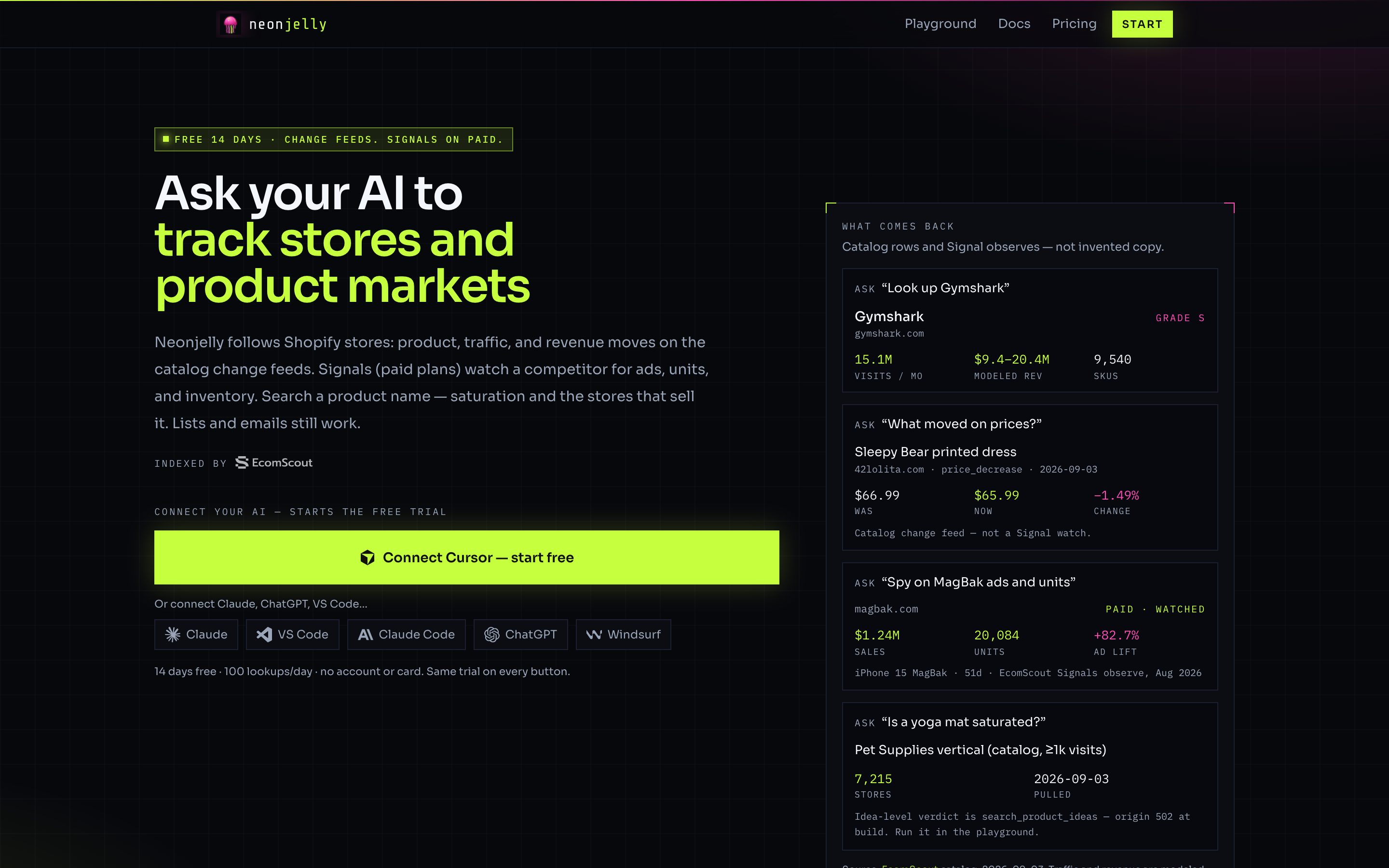
The home hero is the same catalog, restated as four jobs: look up a store (Gymshark again), read a price move, watch ads/units on a paid Signal, ask if a product idea is crowded. Indexed by EcomScout. Connect buttons mint the same trial as /start. If you only remember one sentence from this post: the agent does not “know” 1.37M stores. It has a tool that can look one up.
Sources
- Catalog counts pulled 2026-09-04 from EcomScout — 1,367,109 stores, 700,735 with traffic, 368.9M SKUs. Reproduce with
get_analytics_overvieworget_countries. - Gymshark / Grunt Style cards:
GET /v1/stores?q=…on /start and /playground. Modeled revenue is a band, not GMV. - Keyword tables: Ahrefs Keywords Explorer, Google US, 12-month average volume, 2026-09-04. CPC from API cents ÷ 100.
- Demo video: Neonjelly.io e-commerce MCP demo. Screens from the same walkthrough used on Product Hunt / Arcade.
Run the Gymshark lookup
Also VS Code, ChatGPT, Windsurf…
14 days free · 100 lookups/day · no account or card. Same trial on every button.